We love adventures and even more so if they are in nature, in the mountains, along rivers, lakes, with the green of the mountains…, that is why today we come to talk to you about them, and specifically about one that is increasingly in demand in our area and that we, in particular, love.
It is practiced in river beds or canyons, not requiring much flow like its friend rafting, so it can be practiced all year round, however, avoiding times of high river flooding.
Yes, friends, today we are going to talk about canyoning.
It is well known among adventurers who love to immerse themselves in the water and do sports in the rivers, but we are going to give a brief introduction to what canyoneering is and then get into the nitty-gritty of the question that you all want to know, where to practice this sport.
Well, canyoning, as we already said, is practiced in the ravines or canyons of a river, and it is for this reason that the route can be very different, you know, Mother Nature does not do two things the same. You can find sections with a lot of green vegetation, desert sections, sections with little or no flow… What we say, no two are the same.
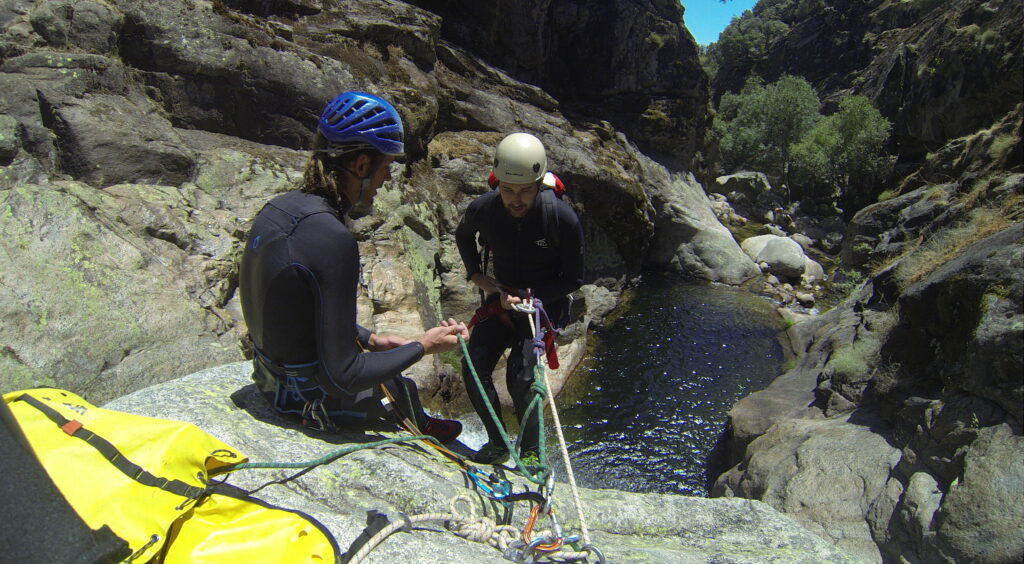
As you can find many different scenarios, you can avoid these by walking, walking, rappelling or even jumping to the bottom of a pool. Don’t you find it exciting? I already have goosebumps just from the excitement of telling you!
Necessary material
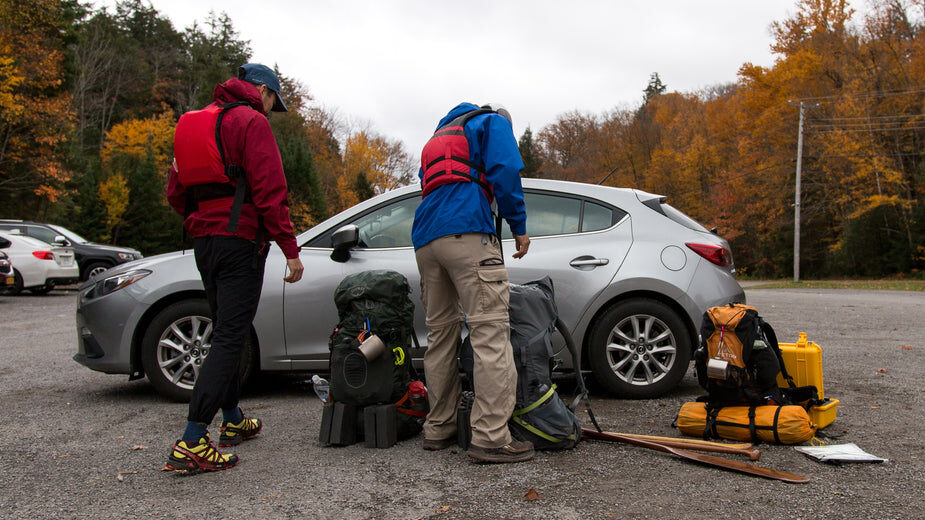
And it is for all of the above that good equipment is necessary and essential, so that safety and fun are guaranteed, which is why you should not lack the following:
- Helmet
- Neoprene wetsuit and booties, depending on the water temperature.
- Canyoning boots
- Harness
- Mechanical blockers
- Canyoning rope
- Knife
- Whistle
- Backpack with drainage
- And you want, you really want.
Progression in ravines
Okay, we already have the material and everything prepared, but how do we do it? Well, as we mentioned before, in the course of the river we can encounter different scenarios, so we are going to have to use several of the following techniques:
- Walk: in dry sections or with a lot of vegetation, along a green river, perhaps the most practical thing is to leave the river bed and walk through that section.
- Climbing: for low jumps in which it is not necessary to use the rope, having the wall with small projections to be able to support ourselves with hands and feet and descend.
- Climb or climb: the opposite of the previous item. It is not usually common in canyoning, but we can find this peculiarity.
- Handrail: horizontal progression along a vertical wall. It is usually necessary to overcome an obstacle or when there is a strong fall of water.
- Rappelling: it is the most common technique, it consists of vertically descending a wall with the help of a rope.
- Swimming: duck into the water! It’s time to swim. When the water temperature is very low, it is better to wear a good wetsuit!
- Slide: water erosion polishes the stone and creates slides in it, you simply have to lie down and let yourself slide. You don’t need a rope.
- Jumps: there are times when the height to descend is small, the rope is not necessary, ending the slope in a pool of water with sufficient depth, the time has come to jump!
- Zip line: rope descent, you can use it to overcome an obstacle on the route.
A priori it may seem very technical and cause a bit of reservation, however it can be practiced by everyone who has a minimum physical condition, so don’t put off so much technicality!
Quotation or technical grading of a ravine
I want to tell you, without going into much detail, how the technical difficulty of a ravine is graded, so that when you look for one you know in advance what you can find.
The ravines will be measured as follows:
v The letter v followed by a number from 1 to 7 to define the vertical difficulty of the descent, where 1 is very easy and 7 is extremely difficult.
a The letter a followed by a number from 1 to 7 to define the difficulty due to the aquatic nature.
IV A figure in Roman numerals from I to VI to quantify the magnitude or commitment of the descent.
Thus, a ravine is defined by the following acronyms, for example: v3 a4 VI.
Canyoning in Cáceres
Let’s get into the subject, what we like, the possibilities that you can find in our land and, that is why, we will talk about the province of Cáceres.
Increasingly we can find more examples of ravines to descend in our area.
We do not know all of them and we are sure that some of them escape us, but we have set up a research team (which has nothing to envy of that of “La Sexta”) to make a list of all the available options.
You can tell us if you know of any different ones.
Here we go!
Barranco Chorrito de los Ángeles
 In the town of Ovejuela, in the Las Hurdes region, province of Cáceres.
Difficulty: V4 A1 II
Vertical descent in the heart of Las Hurdes. Great aerial environment frequented by vultures and other birds of prey. Normally with little flow, recommended after rain.

Ravine Chorrerón del Tajo
Caminomorisco, in the region of Las Hurdes, province of Cáceres.
Difficulty: V3 A2 II
Descent around the quite well-known and visited Chorrerón del Tajo waterfalls. Difficult and narrow access at the top of the waterfalls to begin the ravine. Virgin ravine, little frequented.
Ravine of The Papuans
Jerte, in the Valle del Jerte region, province of Cáceres.
Difficulty: V3 A3 III
We already talked to you in another post about this ravine, it is the first that has been commercialized, followed by many others, later we will talk about the companies in the area that are dedicated to accompanying the brave and adventurous.

Ravine of Las Nogaledas
Navaconcejo, in the Valle del Jerte region, province of Cáceres.
Difficulty: V3 A2 II
One of the most beautiful ravines in our opinion, due to the layout itself and the area through which it runs. Technical ravine with continuous rappels, one of them 30 meters.
Barranco de Los Hoyos
Jerte, in the Valle del Jerte region, province of Cáceres.
Difficulty: V2 A2 I
Ideal ravine to start descending canyons. Best time to do it in spring with the cherry trees in bloom. Close to the Los Papúos ravine.
Ravine of Garganta Mayor
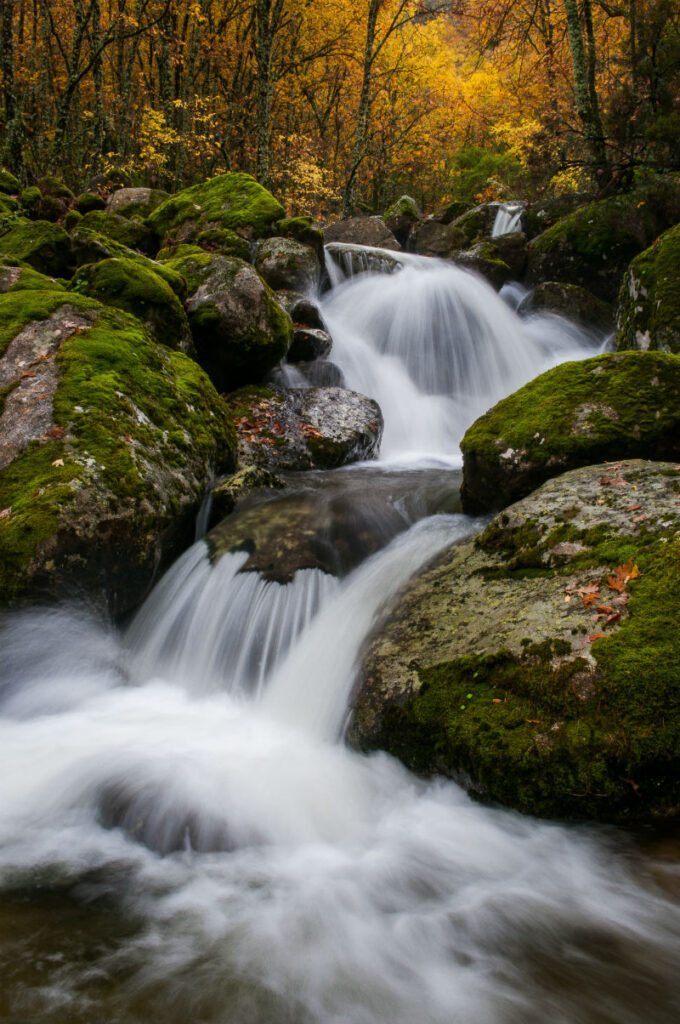
Garganta la Olla, in the region of La Vera, province of Cáceres.
Difficulty: V3 A1 II
This ravine begins in Chorrera Mayo, with rappels, ending in a pool with the possibility of jumping.
Barranco de Chorrera de la Mora
Aldeanueva de la Vera, in the region of La Vera, province of Cáceres.
Difficulty: V3 A1 III
In the heart of the Sierra de Tormentos, you can contemplate the wonderful views of the entire region.
Ravine El Gargantón
Guijo de Santa Bárbara, in the region of La Vera, province of Cáceres.
Difficulty: V2 A2 II
This ravine has an easy and short approach. Recommended in spring or autumn. Open granite rock with some small boxed areas. Its longest rappel is 15 meters.
Las Meñas Ravine
Viandar de La Vera and Losar de la Vera, in the region of La Vera, province of Cáceres.
Difficulty: V4 A2 III
Ravine not very well known and difficult to approach, but once you do it, it is very worth it with its rappels of up to 60m.
Garganta de la Hoz or Vera ravine
Villanueva de la Vera, in the region of La Vera, province of Cáceres.
Difficulty: V2 A3 III
Ravine in the heart of the Sierra de Gredos, it presents several jumps, slides and rappels that make this descent a beauty.
All the Wikiloc tracks that I have left you are just some examples of what you can find in this application but there are many more.
I leave you this link in which you can search by municipalities: https://es.wikiloc.com/rutas/descenso-de-barrancos/espana/extremadura
If you are not yet specialized in this world of canyoning, you do not know how to use ropes and insurance, we recommend that you hire a company with specialized personnel who will accompany you throughout the journey, explaining everything you need to know and taking the experience to a higher level.
There are many companies in the area and they all have top professionals but we recommend Origin, Sport and Nature. They carry out a multitude of outdoor activities, do not hesitate to contact them, they will answer all your questions.
That’s it for today’s post, I don’t know about you but I still have my hair on end, could it be that my body is already asking for adventures?